
Data and AI Roadmaps: Failure by Design
What Organizations Need Instead
tl;dr
- Organizations want to become data-inspired1 and typically begin by drawing up a detailed roadmap.
- However, not every part of such an endeavor is plannable, and organizations must distinguish intelligently between planning and exploration2.
- Making this distinction protects investments in data and AI and significantly increases the odds of success.
1 The Understandable Desire for a Plan
In my consulting practice I frequently encounter requests to develop a roadmap that will make an organization "data-driven" or even data-inspired1 [1]. Such projects typically carry "data strategy" in their title, the sponsors are often technical experts within the company — and sometimes a fixed-price offer is explicitly demanded: "What will it cost, what are the milestones, and when will it be done?"
That is entirely understandable. Procurement and controlling operate with budgets, comparability, and planability. Investments in technology and organizational change can be substantial — management needs certainty before committing, especially in times of tight budgets and economic uncertainty.
Yet this is precisely where a paradox lies: the greater the uncertainty an organization faces regarding its use of data and AI, the stronger the desire for a detailed plan — and the less useful that plan actually is as a tool. The certainty being sought is an illusion.
2 Planability as Illusion: A Missing Distinction
The crux of planning: it only works under certain conditions [2, 3, 4]. Those who ignore these conditions waste resources.
Planning anticipates decisions: what, when, how, and by whom something is to be done. The planner makes these decisions based on what is known at the time of planning. As long as the future is sufficiently predictable and implementation produces few surprises, this is a superior approach. If a company wants to migrate its BI landscape to a new data platform and knows exactly how to do it, the project can be planned with precision. Where knowledge of a solution exists — whether in-house or purchased as a consulting service — solid planning is the best foundation for project success.
Such problems are called complicated3. They can be demanding and challenging, but the path to a solution is in principle known or determinable.
Not all problems are complicated, however. Many are complex4: the solution path is unknown because living systems — whether markets or one's own organization — generate surprises that cannot be anticipated in advance. Here, pre-formulated plans quickly become obsolete. What is needed are ideas and experiments from skilled practitioners5, and decisions must be made where new insights emerge, not at the drawing board.
For the journey towards a data-inspired1 organization, this means companies must distinguish cleverly between complicated and complex problem components [2]. The complicated component — such as building IT infrastructure and tools for data management, and designing standardized processes for operating data and AI solutions — can be planned. The complex component — including making strategic decisions, innovating and prioritizing use cases, and changing the organization — requires an exploratory2 approach: the path must first be discovered and cannot be mapped out at the drawing board in advance.
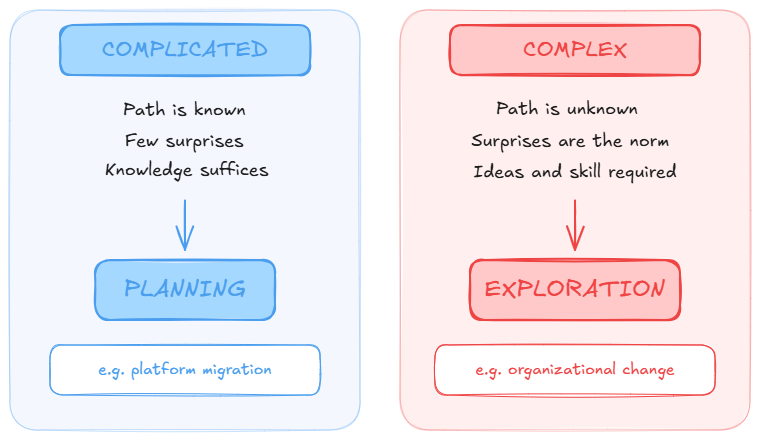 Figure 1: Complicated vs. complex: two problem types, two approaches.
One caveat applies to the distinction: even seemingly plannable endeavors will encounter surprising elements, and conversely, exploration also contains plannable phases. The question is not whether a problem is purely complicated or purely complex, but which character dominates.
Those who fail to make this distinction do not fail by accident — they fail by design: with complex problems, the plan becomes fiction, and the organization loses confidence in the entire endeavor because the approach simply does not match the problem.
3 Protecting Investments: Combining Planning and Exploration
How does an organization approach the possibilities of data and AI without falling into the planning trap — and the waste that comes with it?
The key lies in the right sequence. Before data platforms are designed, the workforce is rallied around AI, and new data-inspired1 ways of working are demanded, strategic clarity is needed first. Dazzled by the hype, organizations often look to solutions before looking at the problems to be solved. Without a strategic frame of reference, there is no basis whatsoever for sound investment decisions. Questions like these must be answered first:
- How do the new technological possibilities affect our differentiation in the market?
- Where are data and AI changing the rules of the game in our industry?
- Which specific problems of our customers can we solve better than before using data and AI?
- What possibilities for new business strategy emerge from this?
The answers to such questions cannot be obtained by working through a methodology. Strategy design addresses complex4 problems and therefore requires an exploratory2 approach [5] that calls equally for creativity and practitioner expertise5. Often it is unclear which data & AI use cases with the potential to transform strategy and the business model even exist — if any do at all. This is where strategy design and the innovation of data and AI use cases converge. Both must go hand in hand and require collaboration between management and data and AI experts [6].
Only the strategic clarity makes it clear which functions6 and capabilities the organization requires. And only then does it make sense to differentiate: which build-up work is complicated3 and therefore plannable? Which requires an exploratory approach? A platform migration with clear requirements and a defined scope can be planned well. Changing the way employees use data for decision-making, on the other hand, cannot be planned.
Those who follow this sequence — strategic clarity first, then differentiated implementation — avoid failure by design and thereby protect their investments in data and AI.
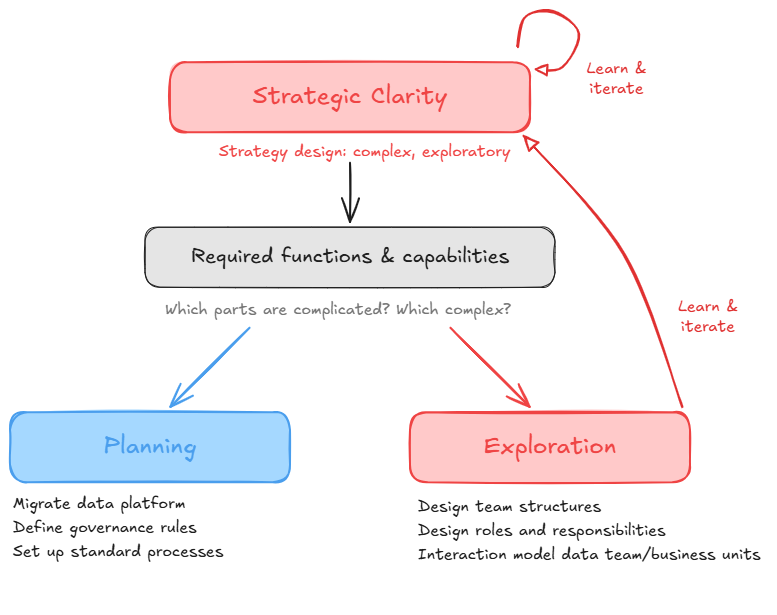 Figure 2: A promising approach to becoming data-inspired.
From strategic clarity the required functions emerge — typically including a data and AI function with its own functional strategy [6].
In practice, this means: do not plan and approve the entire endeavor a-priori, but invest incrementally. Each step — whether a strategy workshop or a pilot — is decided on the basis of the insights gained along the way. Furthermore, skilled practitioners are needed for exploration. Finding them and creating the conditions they require is one of the greatest challenges management faces on the journey to a data-inspired organization.
4 Conclusion and Outlook
The desire for a fully planned roadmap for becoming a data-inspired1 organization is understandable — but dangerous. It mistakes an endeavor that is often predominantly complex4 for one that is complicated3.
Investment protection for data and AI does not come from planning in as much detail as possible, but from the ability to distinguish complicated and complex components and to choose the right approach for each: planning for the known, exploration2 for the unknown. And above all: maintaining the right sequence. First develop strategic clarity, then derive the required functions6 and capabilities, and only then implement in a differentiated way.
This is less comfortable than a seductively detailed roadmap — but it is the difference between the illusion of control and genuine investment protection.
How strategic clarity for data and AI can be developed in practice is described in [6]. How organizations can design their data and AI functions in a dynamic-robust way is the subject of a further article.
References
[1] S. Wernicke, Data Inspired: Erfolgskonzepte für die datengetriebene Organisation. München: Verlag Franz Vahlen, 2024.
[2] G. Wohland and M. Wiemeyer, Denkwerkzeuge der Höchstleister: Warum Dynamikrobuste Unternehmen Marktdruck Erzeugen, 1st ed. UNIBUCH VERLAG, 2014.
[3] Harvard Business Review, A Plan Is Not a Strategy (June 29, 2022). Accessed: March 8, 2026. [Online Video].
[4] R. L. Martin, "Strategy vs. Planning: Complements not Substitutes", Substack. February 15, 2021. Accessed: March 8, 2026. [Online].
[5] R. L. Martin, "The Evolution of the Strategic Choice Structuring Process", Medium. June 23, 2025. Accessed: March 8, 2026. [Online].
[6] J. Linden, "How Most Organizations Get Data Strategy Wrong — and How to Fix It", Towards Data Science. January 20, 2025. Accessed: March 8, 2026. [Online].
Glossary
Footnotes
-
Data-inspired organizations use data, analytics, and AI to continuously experiment and learn, to ask new business-relevant questions, and to realize competitive advantages by combining data, creativity, and intuition. ↩ ↩2 ↩3 ↩4 ↩5
-
Exploration is the activity of discovering an unknown solution path through ideas and experiments. It is the counterpart to planning, which breaks a known solution path into steps in advance. Both are sides of the same distinction: approach — the way an organization works on problems. Which side is appropriate is determined by the character of the problem: planning for complicated components, exploration for complex ones. ↩ ↩2 ↩3 ↩4
-
Complicated problems are low in surprises and can therefore be mastered with existing knowledge. ↩ ↩2 ↩3
-
Complex problems are high in surprises and cannot therefore be solved with available knowledge alone. Ideas are required to address them. ↩ ↩2 ↩3
-
Skill is the person-bound and non-transferable capacity to generate problem-solving intuitions in concrete, often poorly understood situations. It is grounded in talent and deliberate practice and is the decisive resource for handling surprises — since by definition no knowledge yet exists for what is surprising. ↩ ↩2
-
A function is a bundle of specific services that solves a permanently recurring problem. Important: function here does not refer to the organizational unit that produces those services. ↩ ↩2