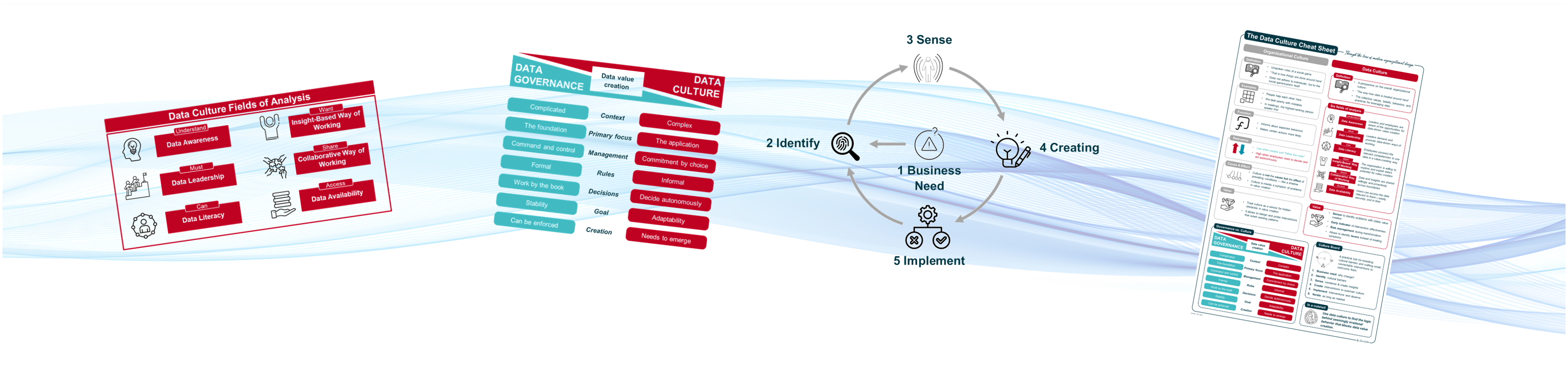
Data Culture Is the Symptom, Not the Solution
The hidden reason your data investments fail
— This article was originally posted on Towards Data Science —
Data culture and data governance are increasingly cited as prerequisites for building data-driven organizations. Both are seen as essential for turning investments in Business Intelligence and Artificial Intelligence (AI) into business value. But here is the catch: data governance can be actively designed — data culture cannot.
This article is a detailed deep-dive of the management summary published on CIO.com. It explores the true role of data culture when an organization sets out to become data-driven — a role that may be quite different from what you expect. Drawing on modern organizational theory, I offer a practical approach to move beyond failed ‘data culture’ initiatives and propose a way of thinking that finally unlocks the value of your data and AI investments.
An appendix provides a Data Culture Cheat Sheet that distills the key points for immediate use.
I am Jens, a business-minded data expert with two decades of experience helping business leaders across industries unlock the full potential of data and algorithms.
tl;dr
- Many data initiatives stay behind expectations not because of technology, but because leaders misunderstand culture.
- Culture is an emergent property of an organization, not an object of design. It can be diagnosed and influenced indirectly, but never directly shaped or engineered into a desired form.
- Therefore, unlike data governance, data culture cannot be treated as a prerequisite for value creation with data and artificial intelligence. It is effect not cause.
- The real use of data culture is diagnostic: like a sensor, it helps to reveal the hidden barriers to leveraging data as an asset.
- Once the root causes of these barriers are identified, leaders can design targeted interventions that improve data value creation. When interventions have an effect, this indirectly shifts data culture as a side effect.
- True data value creation is possible when both are considered together: governance providing the reliable foundation, and culture enabling its effective application.
Table of Contents
- 1 Why do organizations strive for data culture?
- 2 Organizational culture
- 2.1 Limitations of mainstream approaches
- 2.2 Definition of organizational culture
- 2.3 Implications for cultural work
- 3 Data culture
- 3.1 Definition and value of data culture
- 3.2 Fields of analysis for identifying data-cultural barriers
- 4 Data governance vs. data culture
- 4.1 Data value creation
- 4.2 Distinguishing data governance and data culture
- 4.3 The interplay: A virtuous cycle
- 5 A tool to design and probe cultural interventions
- 6 Practical example — how a smarter approach to data culture can save lives
- 7 Conclusion
- Appendix: The Data Culture Cheat Sheet
- References
1 Why do organizations strive for data culture?
Most organizations aim to become data-driven in order to harvest the promised potentials of data being an organizational asset. They aim to apply techniques such as Business Intelligence (BI) or Artificial Intelligence (AI) to re-use operational data for analytical purposes. Applications include:
- Control: Reports or BI dashboards are used for monitoring and oversight
- Automation: Tasks to address complicated business challenges can be automated
- Decision making: Insights derived from data can sometimes support (not substitute!) human intuition required for decision-making to address complex business problems
- Innovation: Creating insights that help ask (and answer) the right questions about customers, competitors, technology, and industry trends
Despite the promised benefits many businesses struggle to unlock the value of their data [1]. And this is not a new problem. BI, Analytics and AI — not just large language models, but also Data Science and Machine Learning — have been around for many decades. Yet, turning data into measurable outcomes remains a challenge for many organizations.
As a result, in addition to strategic clarity [2], the term data culture is increasingly cited as a key success factor for organizations to become data-driven [3].
But what exactly is data culture? Is it really the precondition for turning data into business value? And is it possible to actively shape it into a desired form, such that value creation with data succeeds?
Since data culture is ultimately a perspective on the overall organizational culture, it is crucial to first align on what organizational culture is and how it should be approached.
2 Organizational culture
2.1 Limitations of mainstream approaches
Organizational culture has been a well-established field of study in sociology [ 4, 5, 6] for many decades. Yet many executives report that cultural change and transformation efforts are still among the most difficult challenges organizations face. Although the famously quoted failure rate about 70% [7] is subject to debate [8], there is broad consensus on one point: cultural change is far from trivial and many initiatives stay behind expectations. Why is this the case?
Modern organizational theory based on Luhmann’s system theory [9, 10, 11] offers an answer: Whilst many business leaders implicitly assume that culture is something that can be intentionally shaped, from a systems-theoretic perspective this is not possible. Consequently, the high failure rates of cultural change initiatives are not surprising, as many initiatives are designed based on a flawed assumption when taking on a systems-theoretic perspective.
Luhmann conceptualized organizations as self-reproducing, complex social systems of decision communication. Culture, in this view, is not an object that can be directly designed, but a latent structure of meaning that guides and constrains decisions.
Culture is an emergent product of organizational communication. It can be observed, perturbed, or nudged, but can never be engineered.
Applying these insights can increase the success rate for change and transformation initiatives in practice, justifying the increasing interest in systems theory for researchers and practitioners alike [12, 13, 14].
2.2 Definition of organizational culture
Adopting a systems-theoretic perspective here, organizational culture can be loosely defined as the largely unspoken and partly subconscious rules in an organization, the latter being a particular type of complex social system. Its purpose is to inform members of the organization about the expected behavior and thus makes certain actions more likely than others.
Organizational culture determines how things are done around here.
Culture acts as a so-called undecidable decision premise — a filter that becomes increasingly important in complex contexts, where individuals must decide and act more and more autonomously 14.
Typical examples of such unspoken and subconscious rules (culture) include:
- People help each other here
- We deal openly with mistakes
- In meetings, the highest-ranking person speaks first
2.3 Implications for cultural work
Adopting the systems-theoretic viewpoint provides new insights for cultural work in an organization:
Culture is not the cause but the effect of prevailing conditions.
Thus, the assumption that a ‘good culture’ is a precondition for successful value creation does not hold [14]. Culture is better understood as a symptom of underlying problems (or successes) in value creation.
Several practical consequences follow from the systems-theoretic foundation for work with organizational culture:
- Change context, not people: Leaders should shift focus from changing people or their ‘mindset’ to changing context, as this is the bigger lever for achieving behavioral change.
- Avoid culture-design initiatives: Attempts to engineer an ‘optimal’ target culture have inherently low success rates and should be avoided.
- Use culture as a diagnostic tool: Treat culture as a sensor for hidden obstacles to value creation, rather than a variable that can be directly shaped. Use it to uncover the root causes that explain seemingly irrational behavior blocking value creation.
- Work through small interventions and feedback loops: Design and probe interventions that change the context people work in and observe the feedback, such that the obstacles are resolved. Possible interventions are changes in structures, management systems, the setup of interpersonal exchanges, or protecting (new) ways of working.
- Beware of blueprints: Organizations are complex social systems. As such, you cannot expect causality. What works in one context may fail in another. Therefore, learning from successful organizations has often limited value.
The real value of culture work therefore lies in identifying unseen barriers, experimenting with small context-specific interventions, and allowing more suitable patterns to emerge — rather than trying to engineer a desired target picture of culture, e.g., through designed corporate values.
3 Data culture
3.1 Definition and value of data culture
Data culture is merely a specific perspective on organizational culture. One potential definition might be:
Data culture focuses on the shared habits, values, and informal rules that decide how we use data here to create or protect business value
Because data culture is ultimately organizational culture in action, the principles from Section 2 apply: you cannot engineer a desired data culture directly, nor is it possible to define universal best practices to influence data culture in a desired way.
Instead, organizations should use data culture to identify barriers that block the use of data as an asset, and then probe small interventions which gradually remove those obstacles. When successful, a suitable data culture will emerge by itself, once the value creation with data is functioning effectively.
As for organizational culture in general, the real value of data cultural work lies in its diagnostic power:
- Sensor: Reveals hidden problems in data value creation
- Lever identification: Points to root causes instead of symptoms
- Early indicator: Shows whether an intervention is beginning to work
- Risk management: Flags unintended side-effects during digital transformation
3.2 Fields of analysis for identifying data-cultural barriers
Where to start when identifying data-cultural barriers? It has proven helpful to look at typically relevant aspects of data culture. One possible collection of such aspects are the following six fields of analysis and their corresponding success patterns that often appear when cultural barriers are being addressed successfully. These should not be treated as target patterns for data culture design, but as perspectives to look at in order to identify relevant barriers.
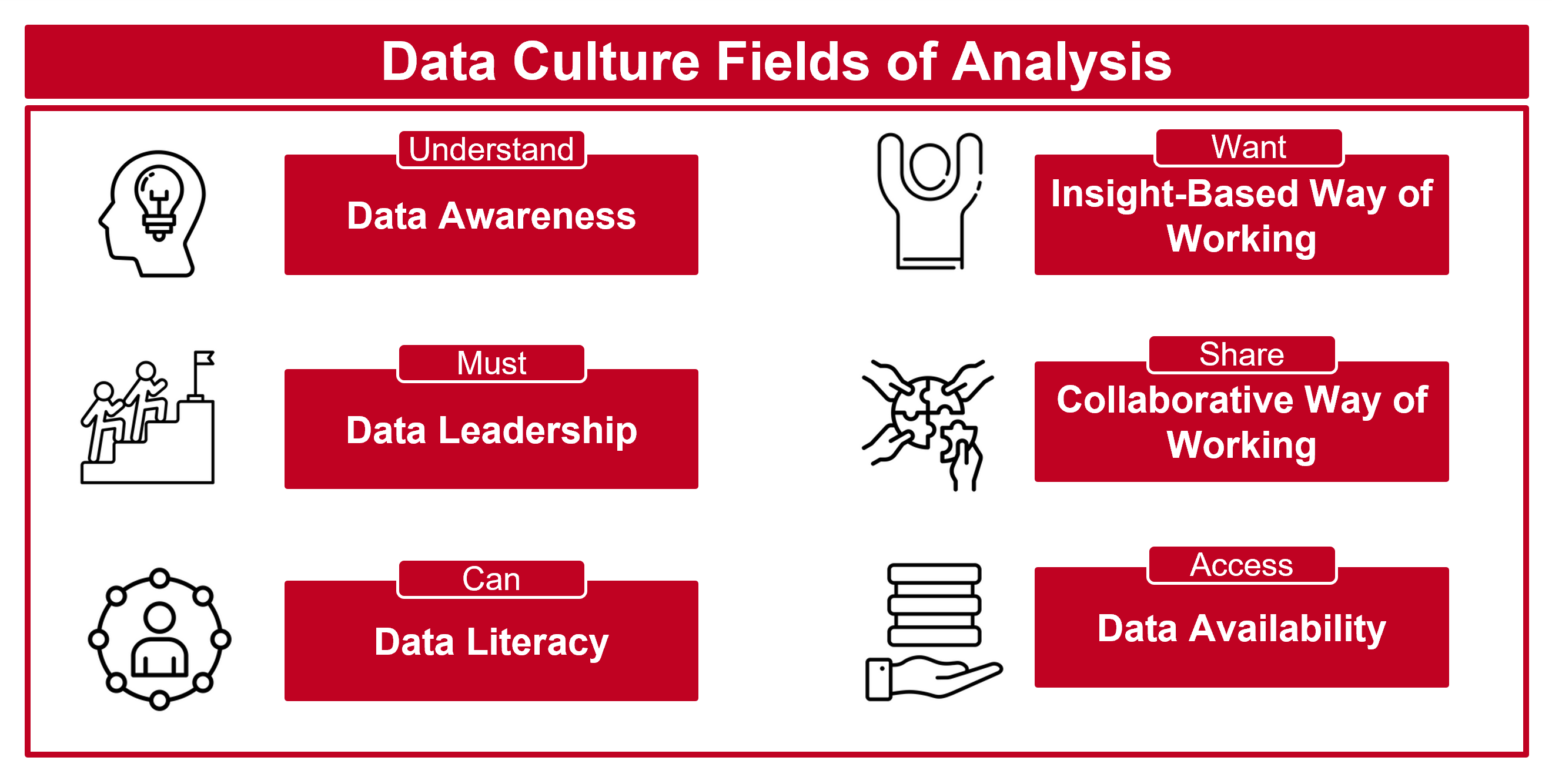 Figure 1: Data culture fields of analysis for identifying data-cultural barriers.
- Data Awareness: Leaders and employees understand both the opportunities and limitations of data-driven value creation
- Data Leadership: Leaders actively demand and champion data-informed ways of working — where they add value
- Data Literacy: All members of the organization possess the relevant interdisciplinary competencies to use data in a value-creating way
- Insight-Based Way of Working: Everyone in the organization is willing to explore and exploit data’s potential for value creation
- Collaborative Way of Working: Data and insights are shared willingly and proactively across boundaries
- Data Availability: Users can access the data relevant to them — easily, securely, and in time
These patterns are signals to monitor, not targets to engineer. Their formation indicates that barriers are being reduced and that data culture is beginning to shift as a byproduct of successful interventions.
4 Data governance vs. data culture
4.1 Data value creation
Data governance is another perceived precondition for organizations to become data-driven. But how does it relate to data culture?
The term data governance is not uniquely defined, but one frequently quoted definition is that of [15]:
“Data governance is defined as the exercise of authority and control (planning, monitoring, and enforcement) over the management of data assets”
Using this common definition, data governance is mainly about implementing processes, roles, and responsibilities to enable sustainable value creation with data. It covers the formal rules to enable value creation with data. These formal rules can be enforced by management with argument, rewards, or punishment. It therefore complements data culture.
Data culture and data governance are two sides of the same coin: governance brings order to the complicated, whilst culture creates adaptability in the complex.
The key is to see data governance and data culture not as separate initiatives, but as two essential modes whose interplay contributes to data value creation: the ongoing organizational process in which data is used, interpreted, and integrated into decisions to generate business value.
4.2 Distinguishing data governance and data culture
The interplay between data governance and data culture is best understood by observing it through the lens of a powerful guiding distinction used in organizational design [14] and management literature [16]: the distinction between the complicated and the complex.
Data governance is the attempt to master the complicated, while data culture is the emergent result of navigating the complex. This guiding distinction manifests across the organization in further corresponding distinctions.
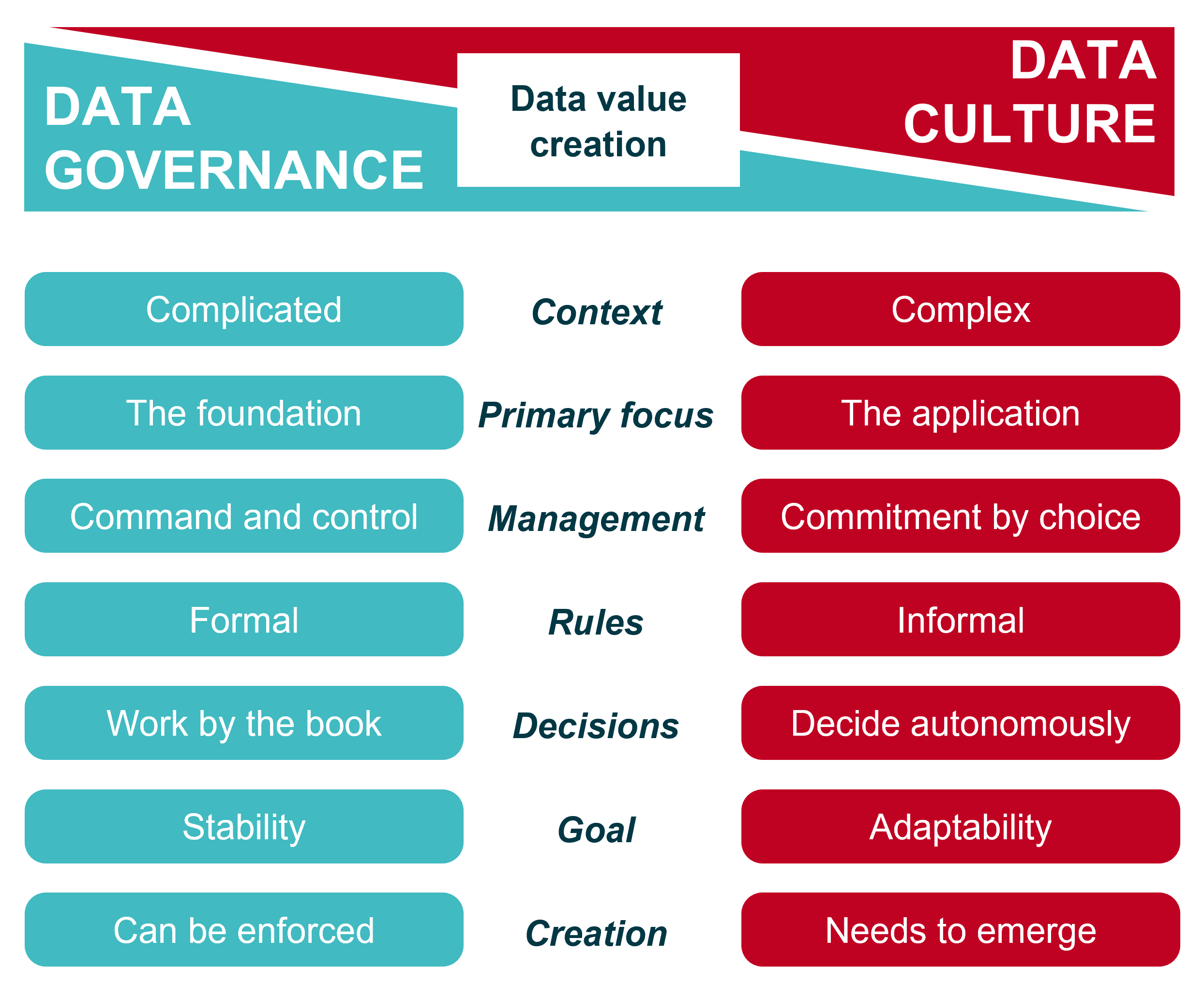 Figure 2: Data governance and data culture are two sides of the same coin for data-driven decision making.
1 Context: Complicated / complex
This is the guiding distinction from which all others follow. Complicated contexts are knowable and predictable, even if they are difficult. Their interactions follow clear cause-and-effect relationships. With a sufficient blueprint and expertise, a desired outcome can be engineered. Data governance is the primary tool for mastering the complicated, e.g. defining who may access data or ensuring that data quality is sufficient.
Complex contexts are unpredictable and emergent. Cause-and-effect relationships are not clear in advance and are constantly shifting. Data culture allows an organization to effectively navigate the complex, e.g. when employees need to decide to address complex business problems, they proactively share analytical insights to improve their decision making.
2 Primary focus: The foundation / the application
This distinction highlights what each mode prioritizes in the journey from data to value. Data governance focuses on creating a reliable foundation. Its primary concern is to render data a stable, predictable, and manageable object — the data asset itself. This is largely a complicated task: it involves defining rules ensuring quality, and structuring access according to clear cause-and-effect relationships.
Data culture, in contrast, enables the effective application of that foundation in the event of the decision-making moment. It determines if and how that stable foundation is actually used by people to navigate uncertainty and create business value.
3 Management: Command and control / commitment by choice
Data governance relies on command and control — the exercise of formal, positional authority. In contrast, data culture cannot be dictated. It enables decision-making in complex contexts through commitment by choice: an emergent phenomenon where people follow informal leaders based on voluntarily granted trust and perceived competence [13, 14].
4 Rules: Formal / informal
Data governance operates through formal, explicit, written rules found in policies and processes. These manifest as tangible artifacts: written policies, process diagrams, role descriptions, or data quality KPIs.
Data culture operates through informal, unwritten social norms and routines that dictate ‘how things are really done around here’. These manifest as invisible but decisive premises that guide action: the level of trust in a dashboard, the perceived relevance of data, the willingness to share insights, or the psychological safety to challenge data-driven assumptions.
5 Decisions: Work by the book / decide autonomously
Data governance requires people to work by the book to ensure consistency and standardization. This is execution — no decision required.
Data culture helps people to decide autonomously in the face of uncertainty. Either by combining the available data with intuition, or by asking the right questions about customers, competitors, technology, and industry trends, which then requires identifying what data might be missing to validate hypotheses.
6 Goal: Stability / adaptability
Data governance aims to create stability, a predictable and reliable foundation where data quality is consistent, access is controlled, and processes follow defined standards. This stability enables reliability and compliance and allows organizations to use data for decision making with confidence.
Data culture aims to enable adaptability, the capability to respond effectively to changing business demands, emerging opportunities, and unexpected challenges. This adaptability allows organizations to survive and thrive in dynamic settings and to leverage data in novel ways.
7 Creation: Can be enforced / needs to emerge
This captures the fundamental difference in their origin and emphasizes one of the key messages in this article. Data governance needs to be designed and enforced, whilst data culture needs to emerge as an indirect result of the prevailing structural conditions.
4.3 The interplay: A virtuous cycle
While the primary path of influence flows from data governance to data culture — with governance providing the reliable foundation for culture to emerge — the interplay goes both ways. A strong data culture brings the formal, complicated structures of governance to life.
Some examples are:
- Data quality — Data governance can define a data quality rule, but a culture of accountability motivates an employee to proactively report an anomaly observation.
- Metadata management — Data governance can mandate the creation of a data catalog, but only a culture of collaboration can ensure its ongoing curation with the rich, contextual, and up-to-date metadata that makes it truly valuable.
- Data acquisition — Data governance can define the processes for acquiring data, but a culture of inquiry constantly generates new business hypotheses that need testing, driving the acquisition of entirely new datasets through those very processes.
This feedback loop between data governance and data culture creates a virtuous cycle. The designed, complicated systems of governance and the emergent, complex behaviors of culture continuously reinforce and improve each other, driving data value creation far beyond what rules alone could enforce. The practical example in Section 6 will also illustrate this effect.
5 A tool to design and probe cultural interventions
How can we put the above theory into practice? How can we identify the cultural patterns that hinder value generation with data and AI and design interventions that address their root causes?
There are certainly different ways to approach culture work in an organization, here I select an approach, which we have successfully applied in our consulting practice. To structure the process of uncovering cultural patterns and designing interventions, we draw inspiration from the so-called Culture Board [17].
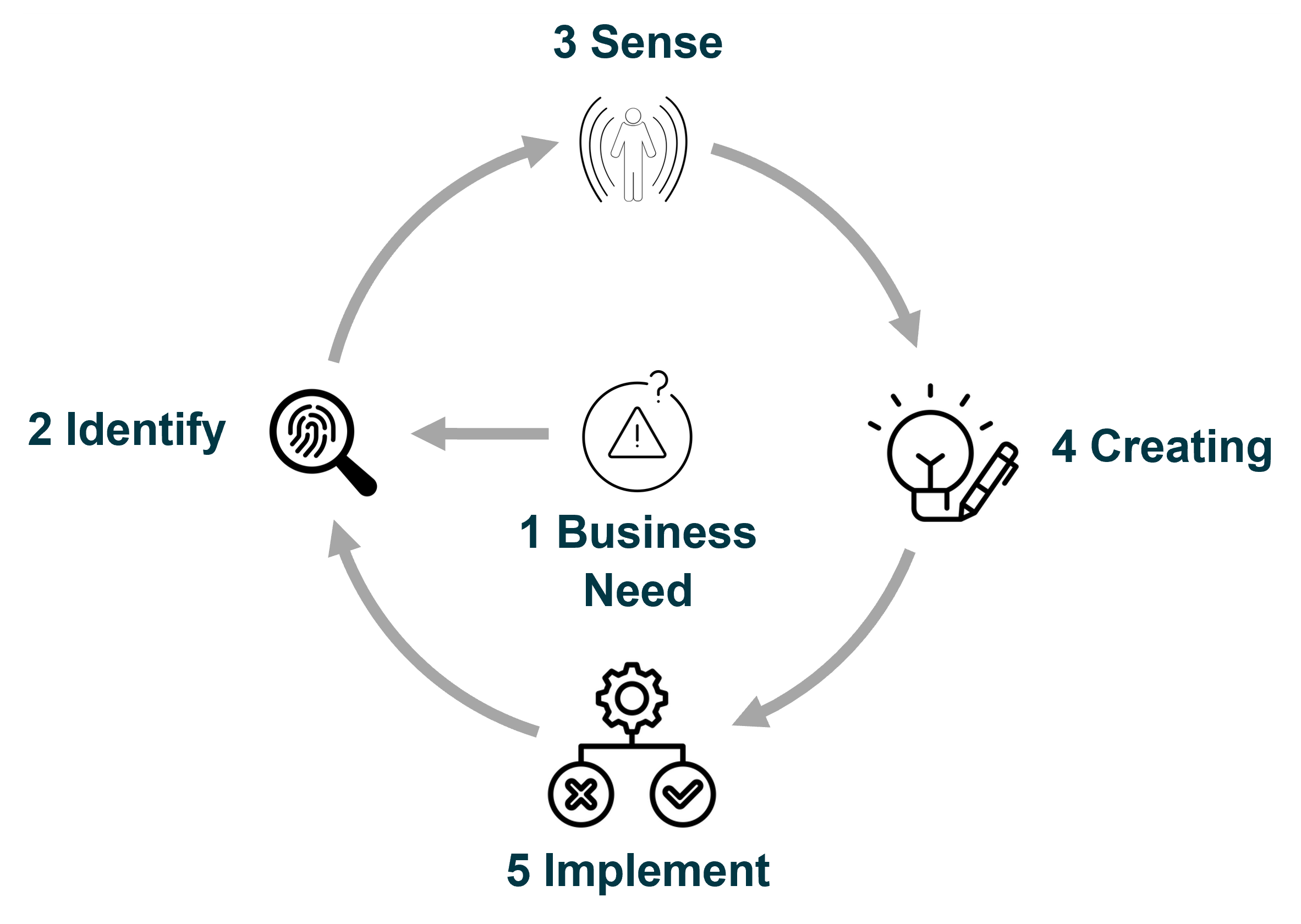 Figure 3: Modified culture board.
Starting from a validated business need, the board guides you through identifying data-cultural barriers, condensing what you discovered, designing connectable interventions, and finally implementing and assessing them. In detail, the five steps are:
- Step 1 — Business Need: Frame your guiding organizational problem clearly. Then trace it to its root cause to avoid treating symptoms. Document the business need to ensure a shared understanding between stakeholders. Hint: becoming data-driven is not your business need, it might be your solution.
- Step 2 — Identify: Analyze the data culture in light of the business need. What cultural patterns are in its way? The six fields of analysis from above can help to spot concrete barriers.
- Step 3 — Sense: Distill, integrate and document the barriers you have discovered to focus on what matters.
- Step 4 — Creating: Design connectable interventions that are likely to address the barriers.
- Step 5 — Implement: Anchor the interventions effectively and sustainably in the organization, then observe and evaluate their impact.
Because success of interventions is never guaranteed in complex social systems — like organizations — , the culture board is used iteratively: loop as often as needed until the the barriers are resolved.
Note that applying the culture board is in itself already an intervention: it exposes employees to previously unseen cultural patterns. These insights alone can already trigger change and have a positive impact on value creation with data.
The following example from healthcare illustrates how the culture board helps put this approach into practice.
6 Practical example — how a smarter approach to data culture can save lives
A hospital faces a high rate of treatment errors threatening patient safety, regulatory compliance as well as its strategic ambition to be a leader in quality of care. A so-called Critical Incident Reporting System (CIRS) is in place to capture and learn from near-misses and errors. However, it remains largely unused. The few reports submitted are often too vague for meaningful analysis.
Step 1: Business Need
To fulfill its strategic ambition and meet regulatory requirements, the hospital must reduce its error rate. This requires a systematic way to learn from incidents. The business need is not just to increase the number and quality of reports, but to create a reliable feedback loop that measurably improves patient safety. This is where solid strategy work [2] plays out, providing prioritization, management attention and the motivation for designing a data-driven organization.
Step 2: Identify
Using the existing culture as a diagnostic tool, interviews with medical staff reveal several powerful, unspoken rules that block the use of the CIRS:
- Fear: “Reporting an error is an admission of guilt. It starts a search for a culprit, not a cause.” This points to a culture of blame, where reporting feels like a personal risk.
- Effort: “We are overloaded as it is. Taking 20 minutes to document something for a system that gives nothing back is a waste of time.” This reveals a conflict with the core value of efficiency.
- Futility: “These reports go into a black box. We never hear what happens with them, so why bother?” This shows a lack of a visible feedback loop, making the effort seem pointless.
Step 3: Sense
Distilling these findings makes the core problem visible: The organization’s context is incompatible with the desired learning ambition. While management officially asks for learning from incidents, the system’s structures, incentives, and routines actually punish the required behavior. The problem is not the mindset of the staff; it is the context in which they work.
Step 4: Creating
Instead of trying to force doctors to better document incidents or initiating a ‘culture change program’, three precise, structural interventions are designed to address the identified barriers:
- To counter fear, a data governance intervention: Clear, binding rules for a fully anonymized and protected reporting process are established. The process is explicitly designed to be ‘blame-free’, a formal guarantee protected by management.
- To counter effort, a technology intervention: The incident reporting platform is redesigned for minimal friction, making documentation as quick and easy as possible.
- To counter futility, a data leadership intervention: A protected, interdisciplinary learning team is created, sponsored by a senior manager. This team is shielded from the daily efficiency pressures and has the mandate to analyze the reports, develop concrete improvements (like new checklists), and, crucially, communicate successes and learnings back to the organization.
Step 5: Implement
The interventions create a positive feedback loop. Time to document incidents reduces significantly. As the first reports are handled under the new, protected process, staff see that it is safe and start providing detailed incident reports. The learning team can develop and optimize a surgical checklist based on early reports, which demonstrably reduces a specific class of error. This tangible success is widely communicated, proving the CIRS’s value, reinforcing report documentation further.
As a result, the quantity and quality of reports increase significantly. A new culture of psychological safety and data-based learning begins to emerge — not as a planned goal, but as a side effect of the tailored change in structural conditions.
7 Conclusion
Data culture is not a set of values to be designed and rolled out, but an emergent property of the organization. It is the effect, not the cause, of successful value creation with data and AI. In contrast to data governance, it cannot be engineered or demanded.
Stay critical of one-size-fits-them-all best practices for designing a ‘good data culture’. Each organization is a complex social system and reacts differently to interventions. It is emergent — you never know what results you will get when following such recipes. What works in one organization might fail in another.
Instead, use data culture as a sensor. Let it reveal the crucial barriers that prevent your data foundation from being translated into better business decisions. Once these root causes are visible, design small, tailored interventions to bridge this gap, observe the impact, and allow a more effective data culture to take shape as a result.
The culture board is a practical tool for this data-cultural work. It helps leaders surface barriers, design targeted interventions, and iterate until the business need is met and, as a result, new cultural patterns have emerged.
Editorial support (spelling, grammar, wording, literature research) was provided with the assistance of generative AI. The ideas, structure, and arguments in this article are entirely created by the author.
I welcome your feedback, suggestions, and questions. Do you agree, disagree, or have additional thoughts? I look forward to engaging in discussions with you in the comments here on Medium.
Appendix: The Data Culture Cheat Sheet
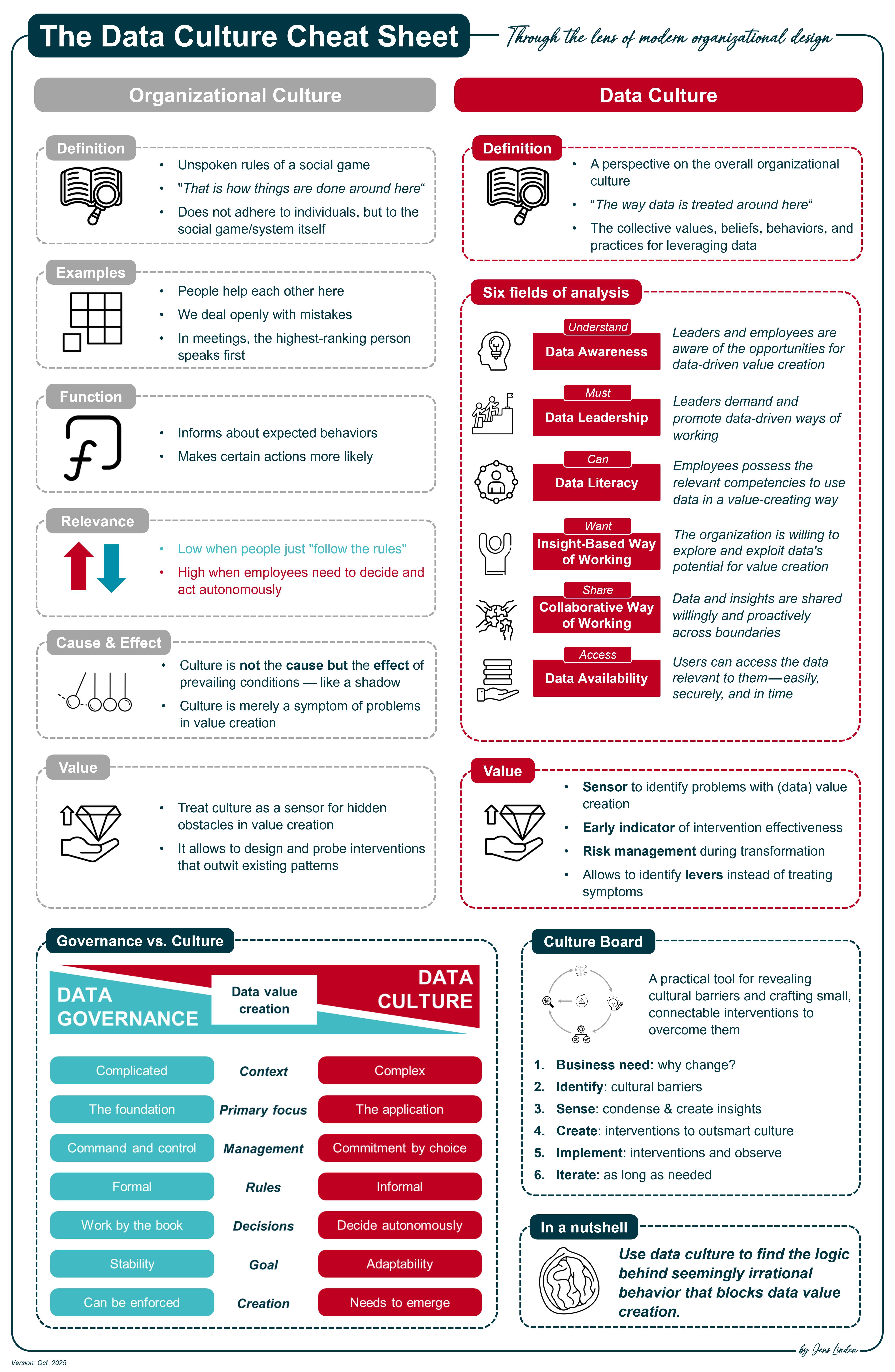 Figure 4: The Data Culture Cheat Sheet.
References
[1] R. Bean, “Why Becoming a Data-Driven Organization Is So Hard,” Harvard Business Review, Feb. 24, 2022. [Online]. Available: https://hbr.org/2022/02/why-becoming-a-data-driven-organization-is-so-hard
[2] J. Linden, “How Most Organizations Get Data Strategy Wrong — and How to Fix It,” Towards Data Science. [Online]. Available: https://medium.com/data-science/how-most-organizations-get-data-strategy-wrong-and-how-to-fix-it-b8afa59f1533
[3] G. Kesari, “Building a Data-Driven Culture: Four Key Elements,” MIT Sloan Management Review, Jan. 23, 2025. [Online]. Available: https://sloanreview.mit.edu/article/building-a-data-driven-culture-four-key-elements/
[4] G. Burrell and G. Morgan, Sociological Paradigms and Organisational Analysis, 1st Edition. London: Routledge, 1979. doi: 10.4324/9781315242804.
[5] G. Morgan, Images of organization, Updated ed., [Nachdruck]. Thousand Oaks,CA: Sage Publications, 2011.
[6] E. H. Schein, Organizational culture and leadership, 1. ed. San Francisco: Jossey-Bass Publ, 1985.
[7] N. Nohria and M. Beer, “Cracking the Code of Change,” Harvard Business Review. [Online]. Available: https://hbr.org/2000/05/cracking-the-code-of-change
[8] M. Hughes, “Do 70 Per Cent of All Organizational Change Initiatives Really Fail?,” J. Change Manag., vol. 11, no. 4, pp. 451–464, Dec. 2011, doi: 10.1080/14697017.2011.630506.
[9] C. Baraldi, G. Corsi, E. Esposito, and K. Walker, Unlocking Luhmann: A Keyword Introduction to Systems Theory. Bielefeld: Bielefeld University Press, 2021. [Online]. Available: https://www.transcript-verlag.de/978-3-8376-5674-9/unlocking-luhmann/?number=978-3-8394-5674-3
[10] N. Luhmann, Organization and decision. Cambridge: Cambridge University Press, 2018. doi: 10.1017/9781108560672.
[11] J. Tække, “Luhmann and Organization Culture -A Systems Theoretical Analytical Strategy Luhmann and Organization Culture -A Systems Theoretical Analytical Strategy,” June 2025. [Online]. Available: https://www.researchgate.net/publication/392760245_Luhmann_and_Organization_Culture_-A_Systems_Theoretical_Analytical_Strategy_Luhmann_and_Organization_Culture_-A_Systems_Theoretical_Analytical_Strategy
[12] D. Seidl and K. H. Becker, “Organizations as Distinction Generating and Processing Systems: Niklas Luhmann’s Contribution to Organization Studies,” Organization, vol. 13, no. 1, pp. 9–35, Jan. 2006, doi: 10.1177/1350508406059635.
[13] M. Poppenborg, Wir führen anders: 24 ½ befreiende Impulse für Manager, 1. Auflage. Berlin: intrinsify.me GmbH, 2021.
[14] G. Wohland and M. Wiemeyer, Denkwerkzeuge der Höchstleister: Warum Dynamikrobuste Unternehmen Marktdruck Erzeugen, 1st ed. UNIBUCH VERLAG, 2014.
[15] D. Henderson, S. Earley, C. Bradley, and Data Administration Management Association, Eds., DAMA-DMBOK: data management body of knowledge, Second Edition
[16] D. J. Snowden and M. E. Boone, “A Leader’s Framework for Decision Making,” Harvard Business Review, Nov. 2007. [Online]. Available: https://hbr.org/2007/11/a-leaders-framework-for-decision-making
[17] F. Heuer and O. Kruggel, Der Kulturarchitekt: mit dem Culture Board Unternehmenskultur analysieren und verändern, 1. Auflage. Düsseldorf: Fachmedien Otto Schmidt KG, 2022.