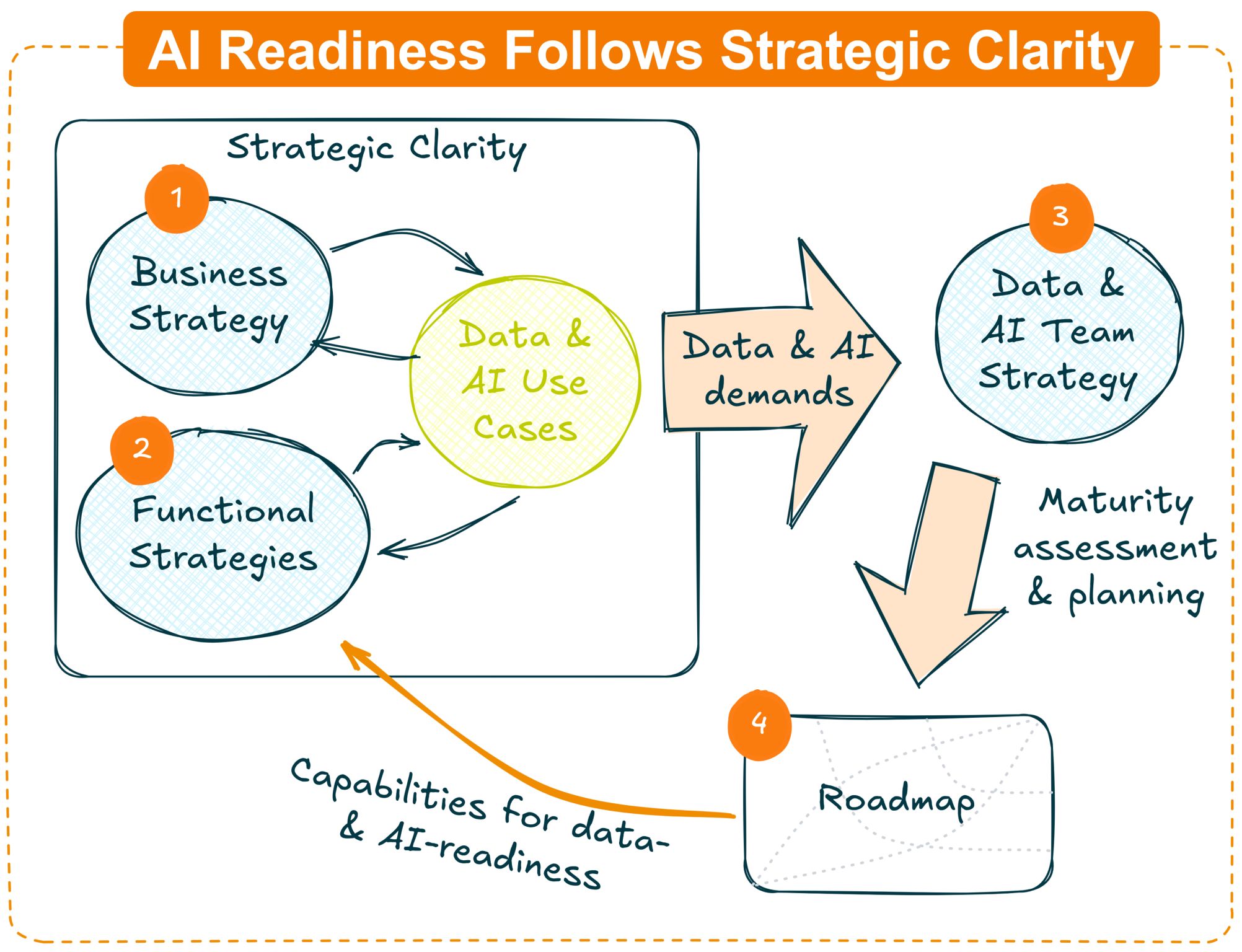
AI readiness follows strategic clarity
Many executives try to get “AI-ready”. But buying technology, launching pilots or jumping into a data & AI strategy project should not be your first move.
Without clarity on business strategy, you just scale noise.
As CEO or business unit leader, you need answers at four levels before “AI-ready” makes sense:
1. Business strategy Where exactly will data, analytics and AI help you win in the market? Will you be an analytical competitor that outperforms others with data and AI – or is AI mainly an operational imperative? The answer must come from your business strategy – and therefore your executive team. No CDO, data scientist or AI engineer can answer this for you. But they should support you in exploring and evaluating the possibilities through data & AI use case innovation & validation.
2. Functional strategies Every function – sales, marketing, operations, finance, HR, R&D – needs a view on how data and AI will change its contribution to value creation. Which decisions will be data-inspired? Where is the real automation potential? This is where further data & AI demands are defined – and where expectations for leadership, skills and ways of working in each function become explicit.
3. Data & AI team strategy Only then does it make sense to ask: what should our data & AI team actually do? Your “data & AI strategy” is the strategy of this team: Which internal customers do we serve, with which services, at what level of ambition? Technology choices are part of this strategy in alignment with IT.
4. Roadmap and maturity Once the direction is clear, you can look at gaps in data, skills, governance, platforms, etc. and build a roadmap to close these gaps. Starting with generic maturity assessments or tooling, without the three levels above, is comfortable – and largely pointless.
Blunt question:
If your business and function strategy is vague on how you want to win with data and AI – how can you seriously evaluate whether you are AI-ready or not?