Back to Insights
LinkedIn Post·
Seven Distinctions to Become Data-Inspired
Data Culture
Data Strategy
Data Leadership
Data Governance
AI
LinkedIn Carousel
Seven distinctions between Data Governance and Data Culture
The distinctions we use determine what we see in an organization, and what we stay blind to.
Take a common blind spot: the distinction between a plan and a strategy. When leaders confuse the two, they try to plan the unplannable. They demand detailed timelines for complex transformations, only to find the plan is outdated the moment it's written.
Distinctions matter when navigating organizational challenges and are helpful when designing data-inspired organizations.
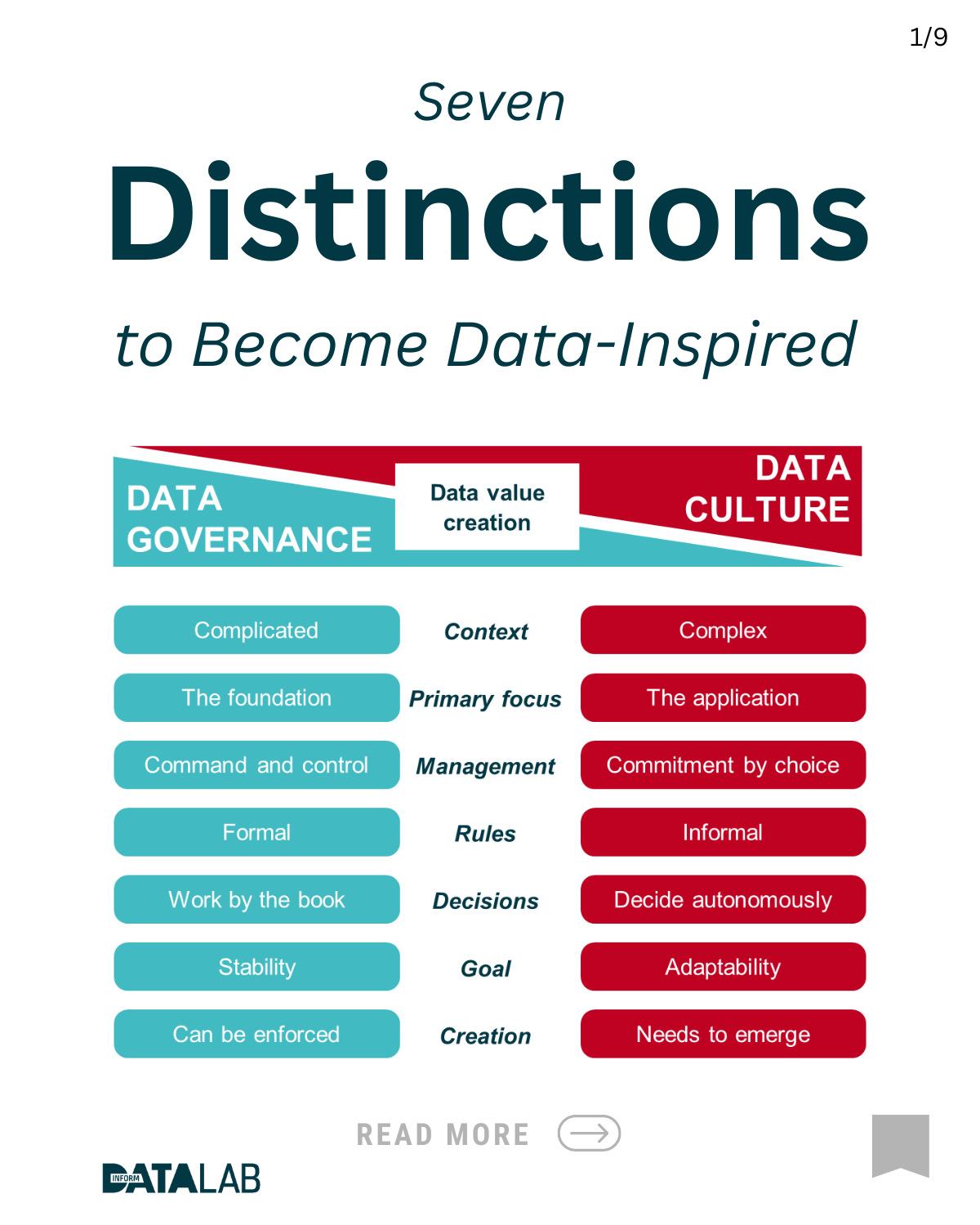
Here are 7 distinctions I use contrasting data governance and data culture:
- Complicated / complex: What is the nature of your context? If there are clear cause-and-effect relationships, data governance can be used to master the complicated (e.g., defining access policies). Data culture allows you to navigate the complex (e.g., deciding autonomously rather than obey).
- Foundation / application: Are you building the data foundation or enabling the application of analytics or AI to business problems? Data governance masters the complicated task of building the data foundation. Data culture enables its application to complex business problems.
- Command and control / commitment by choice: What type of management do you need? Data governance relies on command and control, while data culture cannot be dictated.
- Formal / informal: Do you need formal rules, or do informal ones (culture) stand in the way? Data governance operates through formal, explicit, written rules found in policies and processes. Data culture operates through informal, unwritten social norms.
- Work by the book / decide autonomously: What behavior do you expect from staff? What does the situation require? Data governance requires people to work by the book to ensure consistency and standardization. Data culture empowers people to decide autonomously in the face of uncertainty.
- Stability / adaptability: Is your goal stability? Then data governance helps to create a reliable, consistent foundation. Data culture enables the adaptability needed for dynamic settings.
- Enforced / emergent: Can the outcome be enforced, or does it need to emerge? You can enforce a data governance rule. You can only create the conditions for a data culture to emerge.
Sharpen the polarization of your organizational glasses!
Which distinction in your organization creates the biggest blind spot right now?