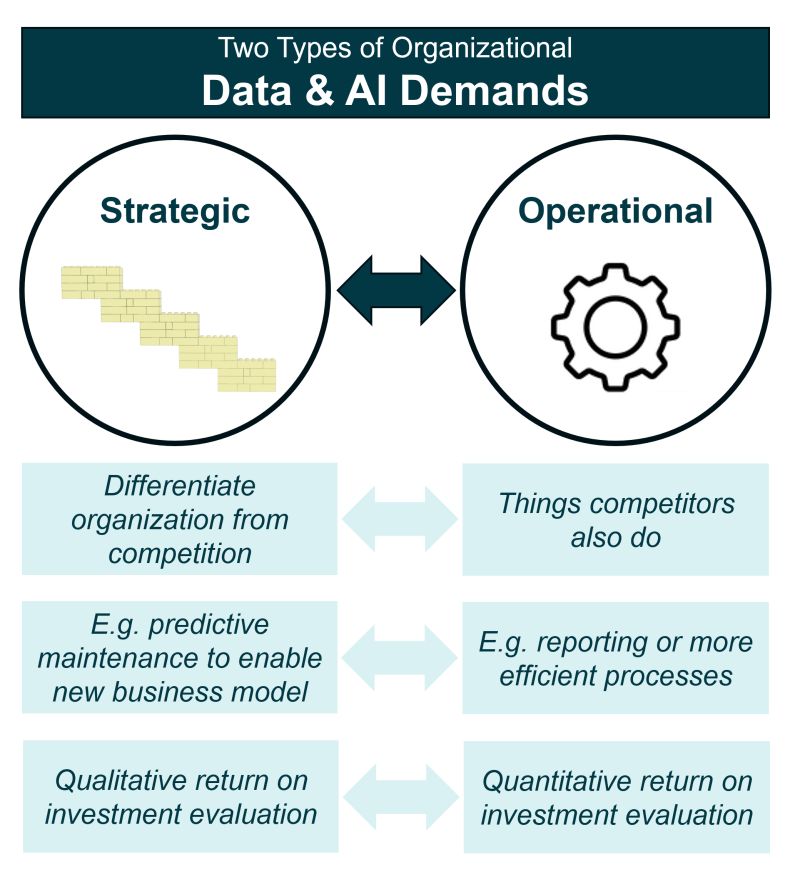
Two Types of Organizational Data & AI Demands – and Why the Difference Matters
Data, analytics, and AI demands arise from two fundamentally different sources: strategic or operational data demands. Understanding the difference is crucial for prioritizing resources, guiding investments, and making informed decisions about Return on Data Investment (RODI).
Strategic vs. Operational Data Demands
-
Strategic data demands are directly tied to business strategy. They enable or sustain competitive advantage and drive fundamental shifts in the business model.
Example: A manufacturer transitioning from selling equipment to offering services relies on predictive maintenance and IoT analytics. Optimizing machine uptime and reducing failure risks is mission-critical—making them strategic data and AI demands.
-
Operational data demands are essential but do not differentiate the organization. They involve capabilities that everyone else also needs to stay competitive.
Example: Standard reporting, dashboards, and efficiency-boosting analytics. While valuable, these do not provide a unique market position—they are operational imperatives.
Why This Distinction Matters
-
Prioritization & Investment: The differentiation helps to prioritize data and AI resources and guide investments.
This is, in fact, the task of a data or AI strategy—i.e., the strategy of a function providing data or AI-related products or services, most often to internal customers. The differentiation is therefore a key input for designing a data strategy.
-
Return on Data Investment (RODI): Another reason to distinguish between both types of data demands is RODI discussions, which data leaders are often required to lead.
Operational demands require efficiency and clear quantitative RODI measurement. The organization needs to fulfill these demands as cost-efficiently as possible. In addition, quantitative monitoring and evaluation of RODI are appropriate.
Strategic demands often require a qualitative evaluation—balancing costs against long-term competitive benefits rather than short-term financial returns. A purely quantitative approach may be misleading. The costs must be carefully weighed against the strategic benefits the data and AI demands create. In this case, a more qualitative approach based on the experience and expertise of the business strategy design team is needed to assess the impact on the organization's strategic bet versus the costs of realization.
You find more details in my latest article on Towards Data Science.
How do you manage your organizational demands for data, analytics, and AI?
Do you distinguish between strategic and operational data & AI demands? Let’s discuss!